
How Often Should You Do PAT Testing? (UK Intervals)
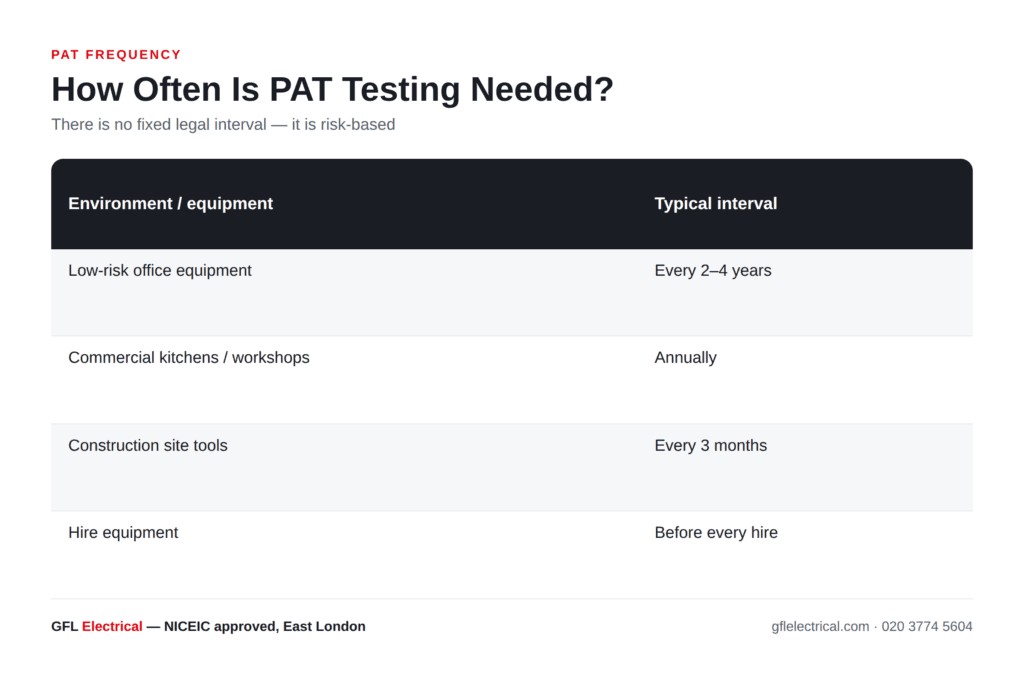
“How often do I need PAT testing?” has a surprising answer: there’s no legally fixed interval. Instead it’s risk-based. Here’s how to work out the right frequency for your equipment and premises.
There’s no set legal frequency
This trips people up. No law says “test every 12 months”. What the law (the Electricity at Work Regulations 1989) actually requires is that you keep electrical equipment maintained in a safe condition. PAT testing is the practical, evidenced way to meet that duty — but you decide the frequency based on risk.
The HSE is explicit that over-testing low-risk equipment is unnecessary, while higher-risk equipment may need more frequent attention. So the answer is “as often as the risk requires” — not a single number.
What drives the frequency
Two main factors:
- The environment. A busy commercial kitchen, a construction site, or a workshop is harsher on equipment than a quiet office.
- The equipment type. Hand-held and frequently moved items (kettles, power tools, vacuum cleaners) wear faster than stationary items (a fixed photocopier, a desktop PC).
Equipment is often grouped by class (Class I earthed appliances vs Class II double-insulated) and by how it’s used (handheld, portable, movable, stationary, fixed).
Suggested intervals (guidance, not law)
As a rough industry guide (always adjust to your risk assessment):
- Construction sites: handheld/portable tools every 3 months, others ~6–12 months
- Commercial kitchens / industrial: higher-use items every 6–12 months
- Offices / low-risk: handheld items ~1–2 years; stationary IT every 2–4 years
- Hotels / public spaces: typically annually for guest-accessible equipment
- Landlord-supplied appliances: commonly checked around change of tenancy and periodically
These are starting points — your own risk assessment sets the actual interval.
The role of user checks and visual inspection
PAT isn’t only about the instrument test. A big part of safety is:
- User visual checks — staff spotting damaged plugs, cracked cases, or frayed leads day to day
- Formal visual inspections — more frequent than full testing, catching most faults
Many faults are found by looking, not testing — so a sensible regime combines regular visual checks with periodic full PAT.
Don’t over-test (or under-test)
- Over-testing low-risk office gear annually wastes money and isn’t required.
- Under-testing high-risk tools is genuinely dangerous and won’t satisfy insurers.
The right approach is a risk-based schedule — and a competent provider will help you set sensible intervals rather than blanket-testing everything yearly. For costs, see our PAT testing cost guide.
Get a sensible PAT schedule
GFL Electrical carry out PAT testing across East London and will help you set risk-based intervals for your equipment and premises — no unnecessary over-testing. See our PAT testing service or call 020 3774 5604.
Based in East London? GFL Electrical are NICEIC-approved electricians covering Leyton, Walthamstow, Hackney, Stratford and the surrounding boroughs. See our PAT testing service, or the areas we cover.

0 Comments