
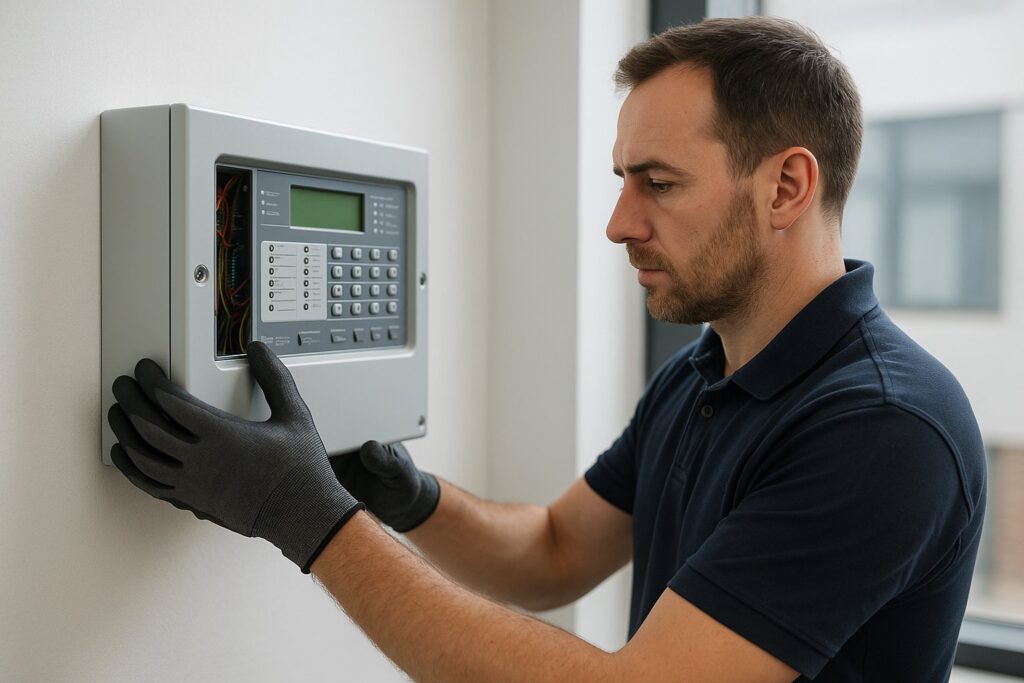
If you run a business or manage a commercial building, BS 5839-1 is the standard your fire-alarm system is designed and maintained to. Here’s what it means, the system categories, and what you need to do.
What BS 5839-1 is
BS 5839-1 is the British Standard code of practice for the design, installation, commissioning, and maintenance of fire detection and alarm systems in non-domestic premises — offices, shops, factories, warehouses, hotels, and the like.
It sits alongside the Regulatory Reform (Fire Safety) Order 2005, which legally requires a fire risk assessment and appropriate fire detection in commercial premises. BS 5839-1 is how you meet that in practice. (For homes, the equivalent is BS 5839-6 — see the difference below.)
The system categories
BS 5839-1 classifies systems by their purpose — this determines how much of a building is covered:
Category M — manual systems
- Manual call points (break-glass) only, no automatic detection. Relies on people raising the alarm.
Category L — life protection (automatic detection to protect people)
- L1 — detection throughout the entire building (maximum protection)
- L2 — escape routes + rooms opening onto them + defined high-risk areas
- L3 — escape routes + rooms opening onto them
- L4 — escape routes only
- L5 — a custom/localised system for a specific risk
Category P — property protection (automatic detection to protect the building)
- P1 — detection throughout the whole building
- P2 — detection in defined high-risk areas
Your fire risk assessment determines the category your premises needs.
BS 5839-1 vs BS 5839-6
A common point of confusion:
- BS 5839-1 = non-domestic (commercial) fire-alarm systems — the categories above.
- BS 5839-6 = domestic premises (homes, HMOs) — uses grades (e.g. Grade D interlinked mains alarms) rather than these categories.
So a shop uses BS 5839-1; a house or HMO uses BS 5839-6. See our smoke alarm regulations guide for the domestic side.
Testing and maintenance
BS 5839-1 sets out a maintenance regime, typically including:
- Weekly test — a manual call point tested (a different one each week) to confirm the system sounds
- Periodic servicing — professional inspection and testing, usually at intervals through the year (commonly six-monthly)
- A log book recording tests, servicing, faults, and false alarms
Like emergency lighting, the records are what evidence your compliance to a fire officer or insurer.
What businesses should do
- Have a fire risk assessment that determines your required system category
- Ensure the system is designed and installed to BS 5839-1
- Keep up the weekly tests and periodic servicing, with a log book
- Address faults and reduce false alarms promptly
Many businesses fold this into a planned maintenance contract alongside emergency lighting and EICRs — see our commercial maintenance service.
Get BS 5839-1 fire detection sorted
GFL Electrical design, install, and maintain commercial fire-alarm systems to BS 5839-1 across East London — to the right category for your premises, with proper records. See our fire & smoke alarm service or call 020 3774 5604.
Based in East London? GFL Electrical are NICEIC-approved electricians covering Leyton, Walthamstow, Hackney and the surrounding boroughs. See our fire and smoke alarm installation, or the areas we cover.

0 Comments