
Smoke Alarm Regulations UK 2026: What’s Required at Home
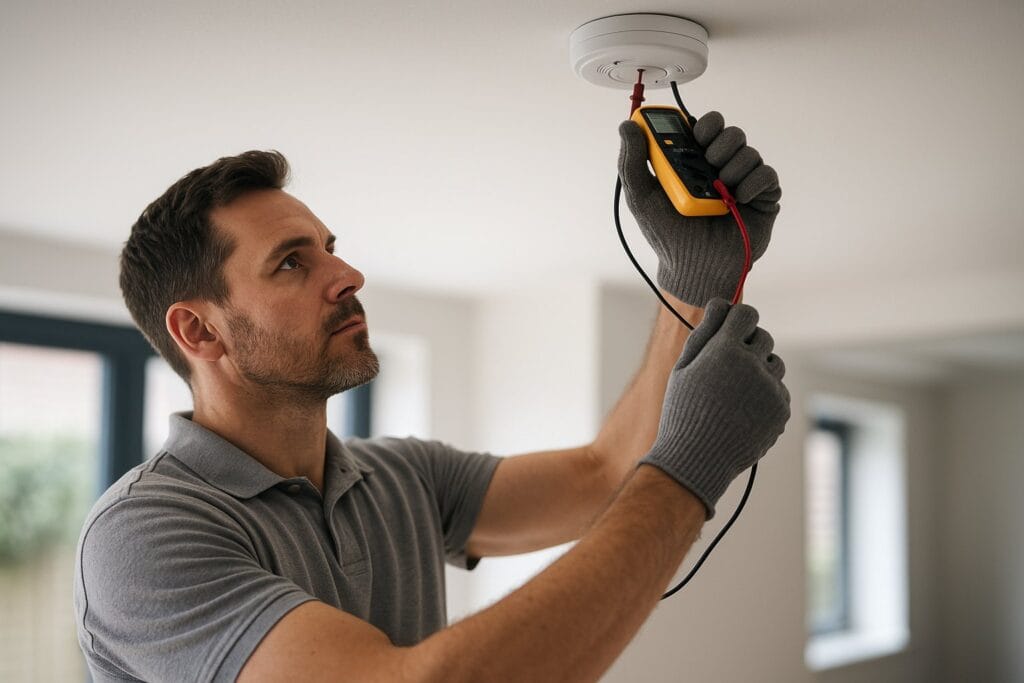
Smoke alarm rules in the UK tightened in recent years, and they’re not the same for owner-occupiers, landlords, and new installations. Here’s what’s actually required in 2026, who it applies to, and why interlinked mains-powered alarms have become the standard for any serious upgrade.
The baseline: smoke and CO alarm rules
Under the Smoke and Carbon Monoxide Alarm regulations (as amended in 2022), the requirements for rented homes are:
- At least one smoke alarm on every storey used as living accommodation.
- A carbon monoxide (CO) alarm in any room used as living accommodation that contains a fixed combustion appliance — for example a wood burner, a gas or oil boiler (gas cookers are excluded).
- Alarms must be repaired or replaced once the landlord is told they’re faulty.
- Landlords must ensure alarms are working at the start of each new tenancy.
These rules apply to both social and private rented homes.
Owner-occupiers
If you own and live in your home, the rented-sector rules aren’t imposed on you in the same legal way — but the same standard is exactly what you should follow, because it’s based on fire-safety best practice. At minimum: a smoke alarm on every level, plus CO alarms where you have combustion appliances. There’s no good reason to do less in your own home.
New installations: BS 5839-6 and interlinked alarms
When alarms are installed as part of building work — a new build, a rewire, or a significant renovation — the standard steps up. BS 5839-6 sets out grades and categories of domestic fire detection. For most homes the target is:
- Mains-powered alarms with a battery backup (rather than standalone battery units), and
- Interlinked alarms — so when one detects smoke, they all sound.
Interlinking is the big safety improvement: a fire starting downstairs at night triggers the alarm in the bedrooms upstairs, where it matters. Interlinking can be hard-wired or done via radio (wireless) interlink for retrofits where running cable is impractical.
Where alarms should go
Good practice placement:
- Smoke alarms on escape routes — hallways and landings on each storey.
- Heat alarms in kitchens (where smoke alarms would false-alarm from cooking).
- CO alarms in rooms with combustion appliances, and ideally near sleeping areas.
- Avoid fitting smoke alarms too close to kitchens or bathrooms to reduce false alarms.
Maintenance
Whatever type you have:
- Test alarms regularly (monthly is the usual advice).
- Replace alarms at the end of their service life — typically around 10 years — as the sensors degrade.
- Don’t disconnect or remove alarms because of nuisance triggers; relocate or upgrade them instead.
Landlords: get it documented
For landlords, the practical approach is to fit compliant alarms, check they work at the start of each tenancy, and keep a record. Pairing this with your electrical safety obligations (the 5-yearly EICR) keeps your property both safe and compliant.
Upgrade to interlinked mains alarms
If your home still relies on standalone battery alarms — or has gaps on some floors — upgrading to interlinked, mains-powered alarms is one of the highest-value safety improvements you can make, and it’s straightforward for an electrician to fit alongside other work. GFL Electrical install and upgrade domestic smoke, heat, and CO alarm systems across East London to the current standards. Call 020 3774 5604 or get in touch.
Based in East London? GFL Electrical are NICEIC-approved electricians covering Leyton, Walthamstow, Hackney, Stratford and the surrounding boroughs. See our fire and smoke alarm installation, or the areas we cover.

0 Comments