
Earthing & Bonding in UK Homes: A Plain Guide
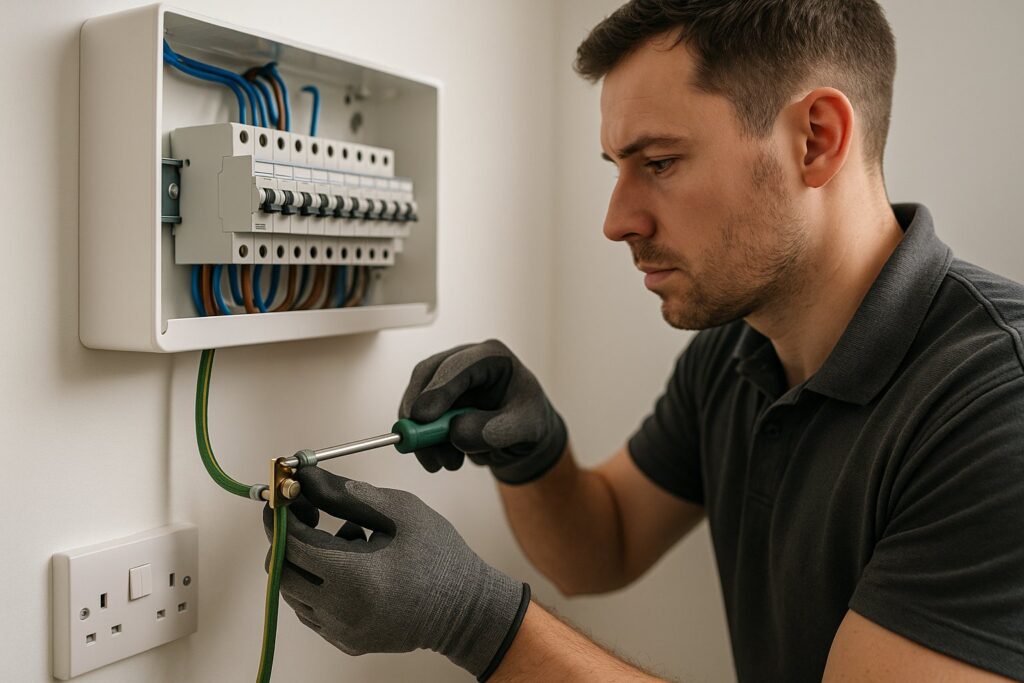
Earthing and bonding are the invisible safety systems that protect you from electric shock — and inadequate earthing/bonding is one of the more common (and serious) findings on older homes’ inspections. Here’s what they are, in plain terms.
What earthing does
Earthing gives fault current a safe path to flow away. If a fault makes a metal part live (say, the casing of an appliance), the earth connection carries that current away and causes the protective device to trip, cutting the power — instead of leaving the metal live and waiting to shock whoever touches it.
No effective earthing = a fault could leave metal parts live with nothing tripping. That’s why it’s fundamental.
What bonding does
Bonding connects metal parts together so they’re all at the same electrical potential — so you can’t get a shock from a voltage difference between, say, a tap and a radiator. There are two kinds:
- Main protective bonding — connects incoming metal services (gas and water pipes, sometimes oil, structural steel) to the main earth terminal. Typically done with 10mm² green/yellow cable near where the service enters.
- Supplementary bonding — additional bonding in higher-risk areas like bathrooms, linking pipes and metal parts (though modern installations with proper RCD protection and main bonding may not require it in all cases).
Why it matters so much
Together, earthing and bonding mean that if a fault occurs, the system disconnects quickly and you’re not exposed to dangerous voltages in the meantime. They work alongside RCDs (which add fast shock protection) — see our RCD vs RCBO guide. It’s a layered safety system, and earthing/bonding is the foundation layer.
Signs yours might be inadequate
Common issues, especially in older homes:
- No or undersized main bonding to the gas and water pipes
- Missing earth on some circuits (common with very old wiring)
- An old earthing arrangement that doesn’t meet current requirements
- No supplementary bonding in a bathroom (where it’s still required)
These often appear on an EICR as C2 (potentially dangerous) observations — see our EICR codes guide.
How it’s checked and fixed
You can’t reliably assess earthing and bonding by looking — it needs testing by an electrician (earth fault loop impedance, continuity of bonding conductors). If it’s inadequate, the fix is usually straightforward: installing or upgrading the bonding conductors and ensuring every circuit is properly earthed. It’s a relatively low-cost but high-importance piece of work.
Why it often comes up in older homes
Homes wired decades ago predate current earthing/bonding requirements, and gas/water bonding was sometimes never added or was removed during plumbing work (e.g. replacing metal pipe with plastic can change what needs bonding). An EICR is the way to confirm yours is correct.
Get your earthing & bonding checked
If your home is older or you’ve had plumbing or wiring work, it’s worth confirming your earthing and bonding are adequate — it’s foundational to your electrical safety. GFL Electrical test and upgrade earthing and bonding across East London. See our EICR testing service or call 020 3774 5604.
Based in East London? GFL Electrical are NICEIC-approved electricians covering Leyton, Walthamstow, Hackney, Stratford and the surrounding boroughs. See all the areas we cover, or get a quote.


0 Comments