
EICR Codes Explained: C1, C2, C3 and FI (2026)
You’ve had an EICR and the report is full of codes — C1, C2, C3, FI. What do they actually mean, which ones count as a “fail,” and what do you have to do about them? Here’s a plain-English breakdown so you can read your report with confidence.
The four codes
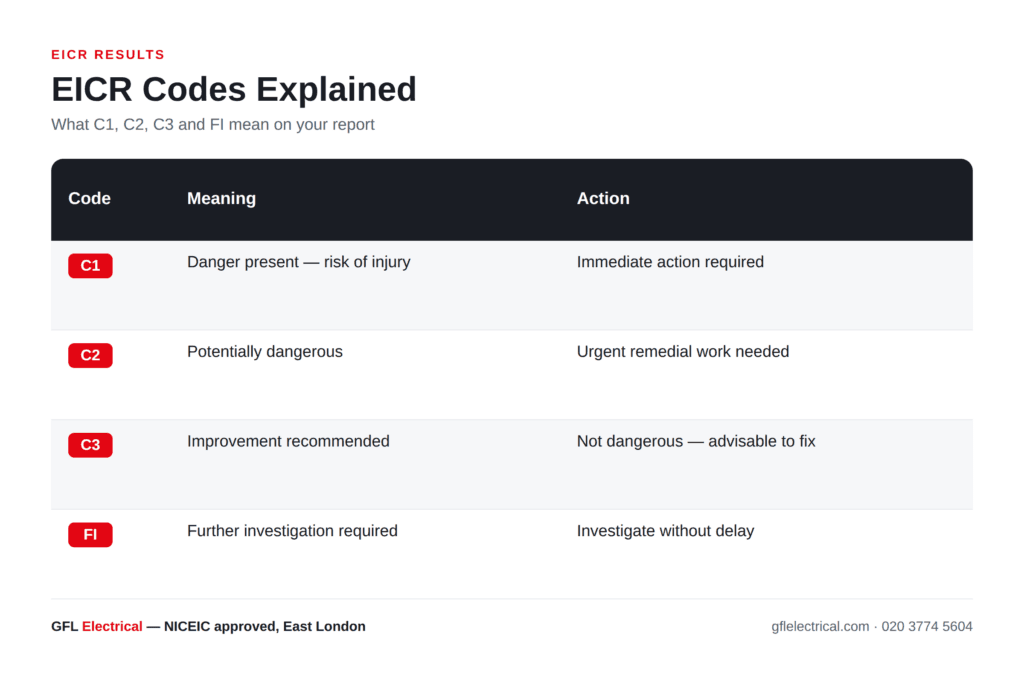
An EICR records observations against four classification codes:
- C1 — Danger present. Risk of injury exists right now. Immediate action required.
- C2 — Potentially dangerous. Not an immediate danger, but could become one. Urgent remedial action required.
- C3 — Improvement recommended. Not dangerous, but improving it would bring the installation closer to current standards. Not a fail.
- FI — Further investigation required. Something needs investigating (without delay) to determine whether it’s a problem.
Which codes make a report “unsatisfactory”
This is the key point. An EICR is marked UNSATISFACTORY if it contains any C1, C2, or FI observation. A report with only C3 codes (and no C1/C2/FI) is SATISFACTORY — the C3s are advisory.
So:
- C1 / C2 / FI present → unsatisfactory → remedial work needed
- Only C3 (or no codes) → satisfactory
What you must do, and by when
- C1 (danger present): must be made safe immediately — a good electrician will often make it safe on the spot or the same day.
- C2 (potentially dangerous): must be put right urgently. For landlords, the law requires remedial work within 28 days of the report (or sooner if specified), with written confirmation afterwards.
- FI (further investigation): investigate without delay to establish whether remedial work is needed.
- C3 (improvement recommended): optional — worth considering, but not required to pass.
Examples of each code
To make it concrete:
- C1: exposed live conductors, a broken socket with live parts accessible, no earthing on a circuit that needs it.
- C2: no RCD protection on circuits that should have it, inadequate earthing/bonding, signs of overheating at connections.
- C3: an older but functional consumer unit, absence of modern labelling, a non-standard but safe arrangement.
- FI: a circuit that couldn’t be fully tested and needs opening up, or an anomaly the inspector can’t resolve on the day.
“Why so many C3s?” — and a word on over-coding
C3s are common and usually nothing to panic about — they reflect the gap between an older installation and current standards, not a danger. Be a little wary, though, of reports that over-code trivial items as C2 to generate remedial work. A trustworthy inspector codes honestly and can explain the reasoning behind each observation. If a C2 seems aggressive, ask them to talk you through it.
After remedial work
When C1/C2/FI items are put right, you should receive written confirmation (and certification for the work done) stating the installation now meets the standard. Landlords must pass this to tenants and, on request, the local authority — it’s what proves compliance. See our landlord EICR rules for the full duty.
Reading your report with confidence
In short: C1 and C2 must be fixed, FI must be investigated, C3 is your choice — and only C1/C2/FI make a report unsatisfactory. If you’ve had an EICR you don’t fully understand, a good electrician will explain it without pressure.
GFL Electrical carry out EICRs and remedial work across East London, with clearly coded reports we’ll happily talk you through. See our EICR testing service or call 020 3774 5604.
Based in East London? GFL Electrical are NICEIC-approved electricians covering Leyton, Walthamstow, Hackney, Stratford and the surrounding boroughs. See our EICR testing and inspection, or the areas we cover.

0 Comments