
HMO Electrical Requirements UK 2026: Landlord Guide
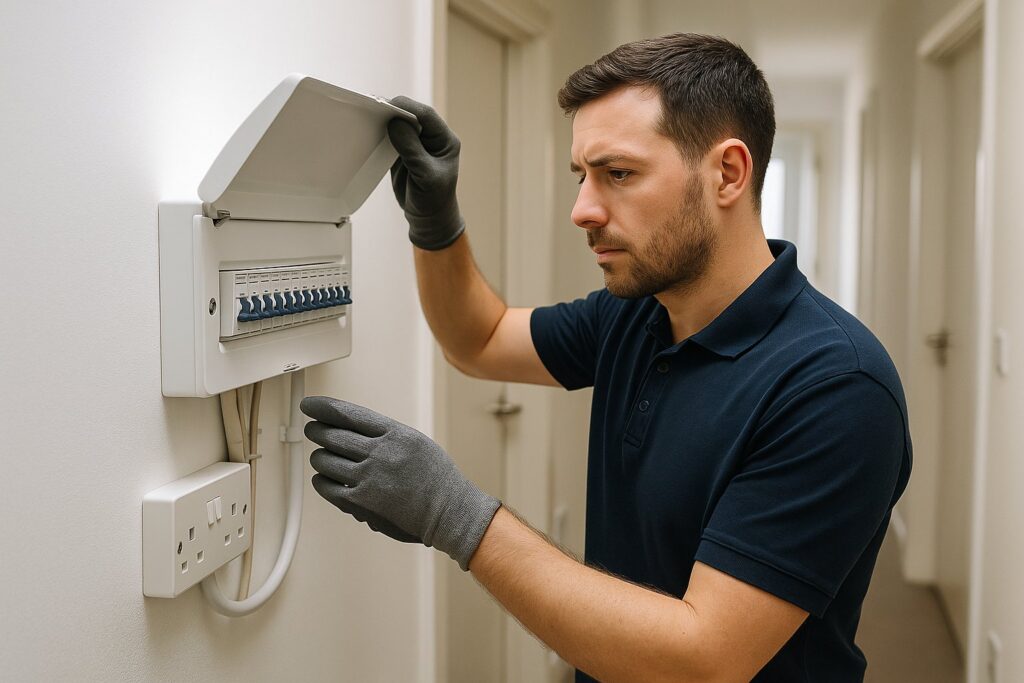
Houses in Multiple Occupation (HMOs) face a higher electrical-safety bar than ordinary lets — more occupants, shared circuits, and greater fire risk mean stricter rules and closer scrutiny. Here’s what landlords must have in place in 2026.
1. A satisfactory EICR every 5 years
Like all private rentals, HMOs must have a satisfactory EICR at least every 5 years — but HMOs are typically inspected more closely given the higher occupancy and shared circuits. You must give tenants a copy, provide it to the council on request, and fix any C1/C2/FI items within 28 days. See our EICR testing service and landlord EICR rules.
2. AFDDs on socket circuits
This is the big HMO-specific requirement. Arc fault detection devices (AFDDs) are required for socket-outlet final circuits in HMOs under BS 7671 Amendment 2 (2022), and made mandatory for HMOs (and student accommodation and care homes) under Amendment 4 (2026). AFDDs detect dangerous arcing that standard breakers miss — a key fire-prevention measure in higher-risk housing. They’re fitted at the consumer unit, so an HMO board upgrade now includes them. See our AFDD guide.
3. Interlinked fire detection
HMOs need a proper graded, interlinked fire detection system (to BS 5839-6, with the grade depending on the property) — not just standalone alarms. When one detects smoke, all sound. Plus CO alarms where there are combustion appliances. See our fire & smoke alarm service.
4. PAT for supplied appliances
If you provide appliances in the HMO (cookers, fridges, washing machines, microwaves), keeping them safe is part of your duty — PAT testing is the standard way to evidence it, on a risk-based interval. See our PAT testing service.
5. Emergency lighting (some HMOs)
Larger HMOs — particularly those over several storeys — may require emergency lighting on escape routes under their fire risk assessment. Your fire risk assessment determines whether it’s needed.
6. Licensing
Many HMOs require a licence from the local council (mandatory for larger HMOs; many boroughs also run additional/selective licensing). Licensing actively checks electrical and fire safety, so your EICR, fire detection, and other measures must be current and documented. In East London, boroughs like Newham, Redbridge (Ilford), and Tower Hamlets operate active licensing schemes.
Pulling it together
For an HMO, the electrical compliance checklist is:
- ✅ Satisfactory EICR (≤5 years), C1/C2/FI fixed in 28 days
- ✅ AFDDs on socket circuits (board upgrade if needed)
- ✅ Interlinked fire detection (graded to the property) + CO alarms
- ✅ PAT on supplied appliances
- ✅ Emergency lighting where the fire risk assessment requires
- ✅ All documented for licensing
Why it’s worth getting right
HMO enforcement is real — councils can issue penalties and, for serious breaches, prosecute. More importantly, the rules exist because shared, high-occupancy housing carries genuine fire and electrical risk. Getting a competent, NICEIC-approved electrician to assess and certify the installation is the straightforward way to stay both safe and compliant.
Get your HMO compliant
GFL Electrical handle the full HMO electrical picture across East London — EICRs, AFDD-equipped board upgrades, interlinked fire detection, and PAT — all certified for licensing. Call 020 3774 5604 or see our HMO EICR & AFDD guidance.
Based in East London? GFL Electrical are NICEIC-approved electricians covering Leyton, Walthamstow, Hackney, Stratford and the surrounding boroughs. See all the areas we cover, or get a quote.

0 Comments