
HMO EICR & AFDD Rules 2026: What Landlords Must Now Do
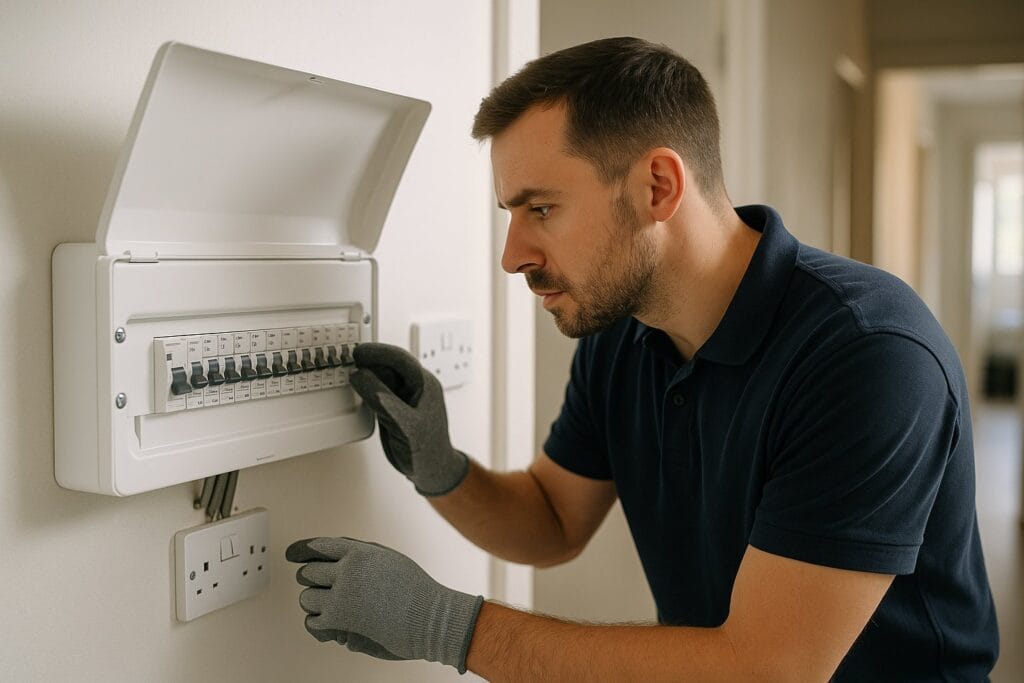
If you let an HMO, the electrical compliance bar has risen. On top of the long-standing requirement for regular electrical inspections, arc fault detection devices (AFDDs) are now mandatory on socket circuits in HMOs under the current wiring regulations. Here’s what that means in practice for 2026, and what you need to have in place.
Two separate obligations
It’s worth separating the two things landlords often confuse:
- The EICR — a periodic inspection of the whole electrical installation, required by law for rented homes including HMOs.
- AFDDs — a specific protective device that must now be fitted to certain circuits in HMOs under BS 7671.
You need to satisfy both. One is an inspection regime; the other is a hardware requirement.
The EICR requirement for HMOs
Privately rented properties in England — HMOs included — must have a satisfactory Electrical Installation Condition Report (EICR) carried out at least every 5 years by a qualified person. You must:
- Get the inspection done and obtain the report
- Provide a copy to tenants (and to the local authority on request)
- Carry out any remedial work flagged as C1 (danger present) or C2 (potentially dangerous) within 28 days (or sooner if specified)
HMOs are often inspected more closely than single lets because of the higher occupancy and shared circuits, so a thorough EICR matters. Our EICR testing service covers HMO inspections to the required standard.
The AFDD requirement explained
An arc fault detection device detects the kind of dangerous electrical arcing — from damaged cables, loose connections, or pinched flexes — that can start fires but won’t necessarily trip a normal breaker or RCD. Because HMOs are higher-risk (more occupants, more appliances, less oversight of how circuits are used), the regulations now treat them differently from ordinary homes.
Under BS 7671 Amendment 2 (2022), AFDDs were required for socket-outlet final circuits (rated up to 32A) in higher-risk residential buildings, HMOs, purpose-built student accommodation, and care homes. Amendment 4 (2026) further cemented this, making AFDDs mandatory on socket circuits in HMOs, student accommodation, and care homes. In ordinary domestic premises they remain recommended rather than mandatory.
When does the AFDD requirement bite?
This is where landlords need advice specific to their property. The requirement applies to the relevant circuits when work is carried out that brings BS 7671 into play — for example a consumer unit replacement, a rewire, or new socket circuits. An EICR may also flag the absence of AFDDs where they’re now expected. In short: if you’re upgrading the board or rewiring an HMO, AFDDs on the socket circuits are no longer optional, and you should plan (and budget) for them.
What this means for your costs
Two practical points:
- AFDDs add to consumer unit costs — they’re more expensive than standard breakers, so an HMO board upgrade now costs more than it did a few years ago. That’s a legitimate, regulation-driven increase, not an upsell.
- Plan upgrades together — if your HMO is due an EICR and the board is ageing, it often makes sense to address the inspection and any AFDD/board work as one coordinated project rather than paying twice for access and certification.
Don’t cut corners on HMO electrics
HMO electrical safety is heavily scrutinised, and the penalties for non-compliance — from enforcement notices to fines — are real. More importantly, the rules exist because shared, high-occupancy housing carries genuine fire risk. Getting a competent, NICEIC-approved electrician to inspect the installation and advise on AFDDs is the straightforward way to stay both safe and compliant.
Get your HMO compliant
If you let an HMO and you’re unsure whether your electrics meet the current rules — EICR due, board ageing, or no AFDDs fitted — it’s worth a proper assessment. GFL Electrical carry out HMO EICRs and consumer unit upgrades across East London to the current edition of BS 7671. Call 020 3774 5604 or see our guidance on landlord EICR rules.
Based in East London? GFL Electrical are NICEIC-approved electricians covering Leyton, Walthamstow, Hackney, Stratford and the surrounding boroughs. See all the areas we cover, or get a quote.

0 Comments