
The Complete UK Guide to EICR Testing (2026): Cost, Frequency, and What Fails
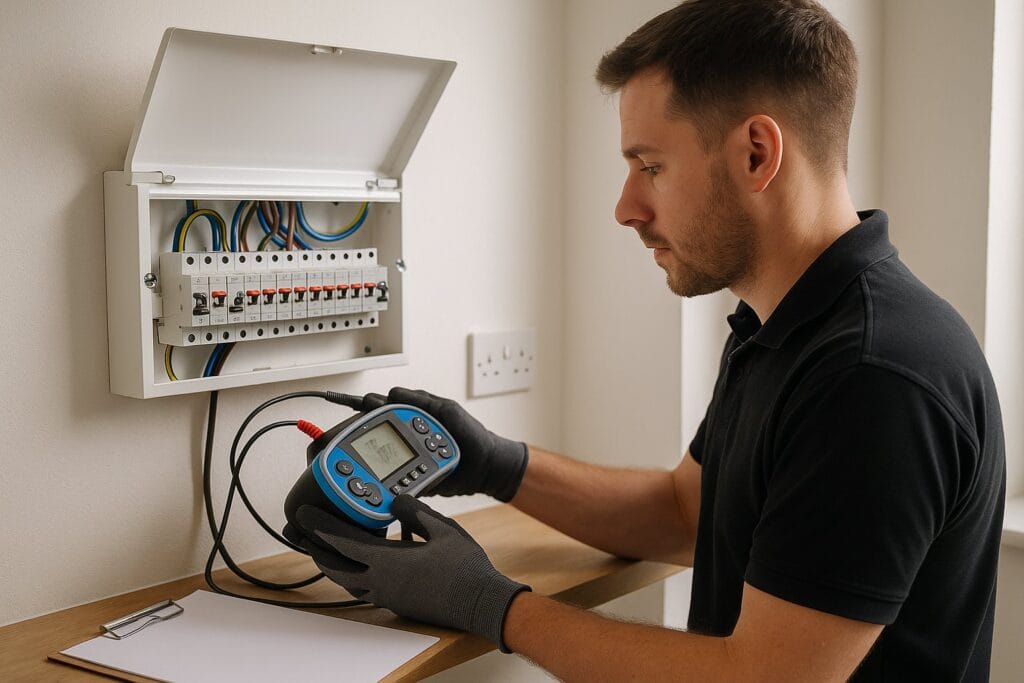
You have been told you need an EICR — maybe by a letting agent, a buyer’s solicitor, or a tenant — and now you are staring at a wall of jargon: condition reports, C1s and C2s, 28-day deadlines, £30,000 fines. It sounds alarming, and the pricing online is all over the place. This guide explains exactly what an EICR is, who legally needs one and how often, what the inspection involves, what it costs in 2026, and — the part that worries people most — what “failing” actually means and what to do about it.
GFL Electrical are NICEIC-approved electricians in East London, and we carry out EICRs for homeowners, landlords, and buyers every week. Here is the honest version.
What is an EICR?
An EICR — an Electrical Installation Condition Report — is a formal inspection of the fixed electrical installation in a property: the consumer unit (fuse board), the wiring, sockets, light fittings, and the earthing and bonding that keep you safe. A qualified electrician tests and inspects each part, then records its condition in a report and gives the installation an overall verdict of satisfactory or unsatisfactory.
It is not a test of your kettle or your TV. It is a health-check of the wiring built into the building — the bits you cannot see behind the walls and inside the board. Think of it like an MOT for your property’s electrics: a periodic, independent check that everything is still safe to use.
Who needs an EICR, and how often?
This is where the rules differ depending on who you are.
Landlords (England) — every 5 years, by law
Since 1 June 2020, under the Electrical Safety Standards in the Private Rented Sector Regulations, private landlords in England must have a valid EICR carried out at least every five years, and before a new tenancy begins. You must give a copy to your tenants, and to the local authority within 7 days if they request it. This is a legal duty, not best practice — and the penalties for ignoring it are steep (more on that below).
Homeowners — recommended every 10 years
If you live in your own home, an EICR is not a legal requirement. The recommendation is to have one at least every 10 years, or sooner if you have just bought the property, are about to sell, notice problems, or the installation is old and has never been checked.
Buyers and sellers
EICRs increasingly come up during house sales. A buyer’s surveyor or solicitor may request one, especially on older properties. Getting one done before you market a home removes a common point of friction in the sale.
What does the inspection actually check?
An EICR combines visual inspection with electrical testing. Your electrician will check, among other things:
- The consumer unit (fuse board) — type, condition, and whether it provides modern protection
- RCD protection — the device that cuts power fast enough to prevent a fatal shock
- Earthing and bonding — the safety connections that protect you if a fault occurs
- Wiring — its type, age, and condition, including signs of overheating or damage
- Sockets, switches, and light fittings — for damage, wear, and correct installation
- Test readings for insulation resistance, polarity, and continuity of protective conductors
To do this properly, the power is usually turned off for parts of the visit while circuits are tested. That is normal and necessary — testing live would not give accurate or safe results.
C1, C2, C3 and FI: what the codes mean
This is the part that causes the most confusion, so here is the plain version. Every issue found is given a classification code, and those codes decide whether the report passes.
C1 — Danger present
A C1 means there is a risk of injury right now — for example, exposed live parts you could touch. A good electrician will make a C1 safe on the spot where possible. Any C1 means the report is unsatisfactory.
C2 — Potentially dangerous
A C2 means a fault that could become dangerous — for example, no RCD protection on circuits that need it, or inadequate earthing. C2s also make the report unsatisfactory and must be put right.
C3 — Improvement recommended
A C3 is advisory. It is something that does not meet the current standard but is not dangerous — and, importantly, a report can still pass with C3s on it. You do not have to act on C3s, though they are often worth doing over time.
FI — Further investigation required
An FI means the inspector found something that needs more investigation to determine whether it is a problem. Like C1 and C2, an FI makes the report unsatisfactory until resolved.
The single most useful thing to understand: “unsatisfactory” does not mean your house is about to burn down. It means at least one C1, C2, or FI was found that needs attention. Often the fix is straightforward.
What commonly fails an EICR?
In our experience across East London’s mix of older terraces, converted flats, and ex-rental properties, the same handful of issues come up again and again:
- Old fuse boards without modern RCD protection — the most common reason for a C2.
- No or inadequate earthing and bonding, especially in older homes that have never been upgraded.
- Damaged or deteriorated cabling, including old rubber or fabric-insulated wiring in properties that have never been rewired.
- Overloaded circuits and dodgy DIY additions — extra sockets or spurs added without proper protection.
- Missing RCD protection on socket circuits and circuits feeding outdoors.
Many of these are about a property’s age and history rather than neglect — and most are fixable without a full rewire.
What does an EICR cost in 2026?
Pricing depends mainly on the size of the property (the number of circuits to test) and where you are, with London and the South East at the higher end. As a 2026 guide for domestic properties:
- Flats and small homes: around £100–£180
- Average 3-bed house: around £150–£250
- Larger properties (4+ beds): £250–£350+
London prices sit toward the upper end of these ranges. A common and reasonable worry is the gap between a cheap quote and an expensive one — but the cheapest EICR is not always the bargain it looks, for a reason we will come to. What matters is that the price is for a thorough inspection by a registered electrician, and that it is clear up front.
Note that the EICR fee covers the inspection and report only — any remedial work to fix C1/C2 issues is quoted separately.
How long does it take?
For a typical home, an EICR takes roughly 2–4 hours, depending on the number of circuits and how accessible the consumer unit and wiring are. Larger or more complex properties take longer. You do not need to be an expert bystander — but someone should be able to give access to all rooms, the fuse board, and the meter.
What happens if you “fail”? Remedial work explained
If the report comes back unsatisfactory, you fix the items that caused it (the C1s, C2s, and any FIs), then your electrician confirms the work and the installation becomes satisfactory.
For landlords, the law is specific: remedial or further investigative work must be completed within 28 days of the inspection (or sooner if the report specifies), and you must obtain written confirmation it has been done. For homeowners, there is no legal deadline, but C1 and C2 issues are about safety, so they should not be left.
Who pays? For a rented property, electrical safety is the landlord’s responsibility, not the tenant’s. For an owner-occupied home, it is the owner’s.
Penalties for landlords who don’t comply
This is why landlords take EICRs seriously. Local authorities can issue financial penalties of up to £30,000 for breaches of the Private Rented Sector electrical safety regulations, and they can arrange remedial work themselves and bill the landlord. Beyond the fine, an out-of-date or unsatisfactory EICR can complicate insurance claims and tenancy disputes. A valid certificate, renewed on time, avoids all of it.
How to choose an assessor — and avoid being over-failed
Here is the uncomfortable truth that comes up a lot: because the same person who inspects can also quote for the remedial work, some people worry that an assessor will fail items unnecessarily to sell themselves the fix. It is a fair concern, and a few simple checks protect you:
Use a registered electrician
Choose someone registered with NICEIC or another recognised body. Registration means their work is independently assessed, and it is the clearest signal of competence. GFL Electrical are NICEIC approved.
Ask them to explain every C1 and C2
A trustworthy electrician will walk you through each coded item, show you the issue, and explain *why* it is a C2 rather than a C3. Vague answers are a red flag. You are entitled to understand your own report.
Remember you can get remedial work quoted elsewhere
The electrician who does your EICR does not have to be the one who fixes the faults. Getting a second quote for any significant remedial work is completely normal and keeps everyone honest.
Check the report is the genuine, signed document
A valid EICR is a formal report signed by the inspecting electrician, listing every circuit and observation — not a one-line “pass” certificate.
Frequently asked questions
How often does a landlord need an EICR? At least every five years, and before a new tenancy. If your last report specified a shorter interval, follow that instead.
Is an EICR a legal requirement for homeowners? No. For owner-occupied homes it is recommended (every 10 years or on purchase/sale), but not legally required. For rented homes in England it is the law.
What does it mean if my EICR is “unsatisfactory”? It means at least one C1 (danger), C2 (potentially dangerous), or FI (further investigation) was found. It does not mean the property is unusable — it means specific items need attention before it can pass.
Do I have to fix C3 items? No. C3 is an advisory “improvement recommended” and a report passes with C3s on it. They are worth considering over time but are not mandatory.
How much does an EICR cost in London? Typically £150–£350+ for a house depending on size, with London at the higher end of the national range. The figure covers the inspection and report; remedial work is quoted separately.
How long is an EICR valid for? Up to five years for rented properties (or less if the report says so), and around ten years is the guide for owner-occupied homes — but the report itself states the recommended date for the next inspection.
Can I be present during the inspection, and will the power go off? Yes, you can be present, and yes — power will be switched off for parts of the visit while circuits are safely tested. Plan around it for anything sensitive like home working or freezers.
What’s the difference between an EICR and a PAT test? An EICR checks the property’s fixed wiring; PAT testing checks plug-in appliances. They are different jobs and different certificates.
Book your EICR with GFL Electrical
If you need an EICR — whether you are a landlord up against the five-year deadline, a homeowner who has never had the wiring checked, or a buyer who has been asked for one — we can help. Tell us the property type and what has prompted the inspection, and we will give you a clear price and a realistic timeframe, with every coded item explained in plain English.
Learn more about our EICR testing service and our landlord electrical safety certificates, or get in touch for a quote.
Based in East London? GFL Electrical are NICEIC-approved electricians covering Leyton, Walthamstow, Hackney, Stratford and the surrounding boroughs. See all the areas we cover, or get a quote.

0 Comments