
Fuse Box Replacement: Cost, Timing, and What’s Involved (2026 UK Guide)
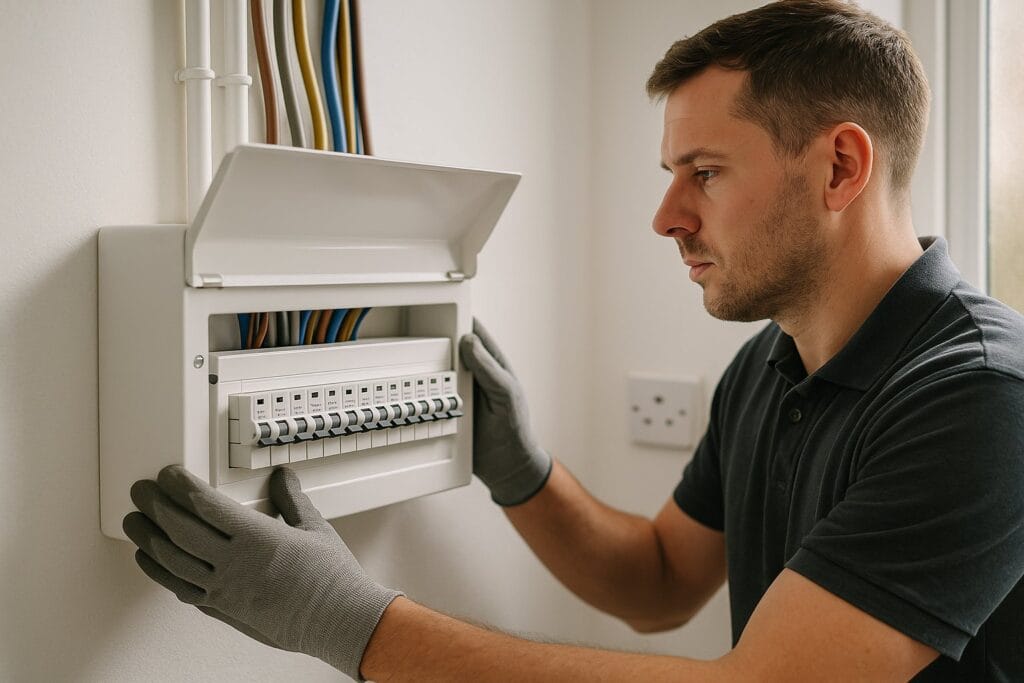
Maybe your fuse box trips every time the kettle and the toaster are on together. Maybe a house survey came back with “older consumer unit — upgrade likely” and you have no idea whether that is urgent or just box-ticking. Or maybe you have looked at your fuse board, seen old-fashioned fuses and not a single test button, and wondered if it is safe. This guide explains when a fuse box genuinely needs replacing, what it costs in 2026, the difference between the board types, and exactly what the job involves — so you can tell a real safety issue from an optional upgrade.
GFL Electrical are NICEIC-approved electricians in East London, and consumer unit replacements are one of our most common jobs. Here is the straight version.
What is a fuse box (consumer unit)?
The “fuse box” — properly called the consumer unit — is the grey box where your electricity supply is split into the separate circuits that feed your home, and where the protective devices live that cut the power when something goes wrong. It is the single most important safety component in your home’s electrics.
Older boards used rewireable fuses (a wire you replaced by hand). Modern boards use circuit breakers and RCDs/RCBOs that detect faults far faster and protect against electric shock — protection that simply did not exist in older units.
Signs you need a new fuse box
Some signs are about safety and some are about age. Here are the ones that matter:
- Old-style rewireable fuses (ceramic holders with fuse wire). These date the board to an era before modern shock protection and are a strong sign it is due for replacement.
- No test button on the board. The “T” or “Test” button is the RCD. No button often means no RCD protection at all — a major safety shortfall by today’s standards.
- Frequent tripping — especially a whole section of the house going off when one appliance is used.
- A burning smell, scorch marks, or discolouration around the unit. This is urgent — treat it as an emergency.
- Buzzing, humming, or crackling from the board. It is never normal and can mean loose connections or arcing.
- A failed or unsatisfactory EICR that cites the board, missing RCD protection, or inadequate circuits.
- Age — a board that is decades old, never upgraded, often flagged when you buy or insure a property.
If you have a burning smell or buzzing, stop and call an electrician now. The rest are reasons to plan a replacement rather than panic.
RCD vs RCBO: which board type?
This is the main choice, and it affects both safety and price.
RCD (dual-RCD) boards
A dual-RCD board groups your circuits under two RCDs. It meets the regulations and protects against shock — but with a catch: if one circuit develops a fault, the whole half of the board it sits under trips, taking several circuits off with it. So a fault in an outdoor socket could plunge half your house into darkness.
RCBO boards
An RCBO board gives every circuit its own combined protection. A fault trips only the affected circuit — the rest of the house stays on. It costs more (typically £200–£400 more), but most electricians now recommend it, especially in homes with EV chargers, home offices, freezers, or anyone who does not want a single fault knocking out half the house.
For most replacements today, a full RCBO board is the sensible choice. We will always explain the trade-off so you can decide.
What does a fuse box replacement cost in 2026?
Pricing depends mainly on the board type, the number of circuits, and the condition of your existing wiring. As a 2026 guide:
- Dual-RCD consumer unit: around £500–£800, including testing and Part P sign-off
- Full RCBO consumer unit: around £800–£1,200, including testing and certification
- London sits at the upper end of these ranges
What can add to the cost:
- More circuits — a larger property needs a bigger board.
- Remedial work uncovered during the swap — if old wiring or earthing is found to be unsafe, it must be put right for the new board to be signed off (a good electrician flags this before starting, not after).
- Earthing and bonding upgrades — older homes sometimes need these brought up to standard.
The quoted price should always include testing and the certificate — a replacement that is not certified is not finished.
What’s involved, and how long does it take?
A straightforward consumer unit replacement is usually a half-day job (3–5 hours), though more circuits or unexpected remedial work extend it. Here is the sequence:
- Power off. Your electricity is switched off for most of the job — plan around anything sensitive like home working or a full freezer.
- Remove the old board and assess the existing circuits, earthing, and bonding.
- Fit the new consumer unit and connect each circuit to its own protective device.
- Test every circuit — insulation resistance, RCD operation, polarity, continuity — to confirm it is all safe.
- Certify the work. You receive an Electrical Installation Certificate, and the work is notified under Part P of the Building Regulations.
You should be left with a labelled board (so you know which breaker is which) and your paperwork.
Part P and certification — why it matters
Replacing a consumer unit is notifiable work under Part P of the Building Regulations. A registered electrician (for example, NICEIC-registered) can self-certify the work and handle that notification for you. This is not optional bureaucracy: the certificate proves the installation is safe and compliant, and you will want it for your home insurance and for any future sale. An uncertified board swap is a problem waiting to surface.
Do you have to replace it, or can it wait?
This is the question we hear most from people buying older homes, where a surveyor has written “older consumer unit — upgrade likely.” Here is the honest framing:
- If there is a burning smell, buzzing, scorching, or repeated tripping — it is not optional. Act now.
- If the board has rewireable fuses or no RCD protection — it is genuinely worth doing soon, because you are missing modern shock protection, even if nothing is actively failing.
- If the board is simply older but sound, with RCD protection already present — it may be a “plan and budget for it” job rather than an emergency. An EICR is the best way to know which category you are in.
A surveyor flags the board because they are not electricians and are covering the unknown — not because they have found a fault. The way to turn “upgrade likely” into a clear decision is an EICR, which tells you exactly what condition your board and wiring are in.
How to choose an electrician for the job
A consumer unit is the heart of your home’s safety, so the installer matters.
Use a registered electrician
Choose someone registered with NICEIC or another recognised body, so they can self-certify the Part P work and their workmanship is independently assessed. GFL Electrical are NICEIC approved.
Get the board type and price in writing
A clear quote states whether it is a dual-RCD or full RCBO board, what is included, and that testing and certification are part of the price.
Expect them to flag remedial work before starting
A professional checks earthing, bonding, and the state of the circuits and tells you about any required remedial work up front — not as a surprise mid-job.
Make sure you get the certificate
You should receive an Electrical Installation Certificate and the Part P notification. Without them, the job is not properly complete.
Based in East London? GFL Electrical are NICEIC-approved electricians covering Leyton, Walthamstow, Hackney, Stratford and the surrounding boroughs. See our fuse box replacement service, or the areas we cover.
Frequently asked questions
How much does it cost to replace a fuse box in 2026? Around £500–£800 for a dual-RCD board and £800–£1,200 for a full RCBO board, including testing and Part P sign-off. London is at the higher end, and extra circuits or remedial work add to it.
RCD or RCBO — which should I choose? RCBO for most homes. It gives each circuit its own protection, so a fault trips only that circuit instead of half the house. It costs a little more but is well worth it.
How long does it take to replace a consumer unit? Usually a half-day (3–5 hours), with the power off for most of it. More circuits or unexpected remedial work can extend it.
Do I legally need a certificate? Replacing a consumer unit is notifiable under Part P of the Building Regulations. A registered electrician certifies the work and notifies it — you should receive an Electrical Installation Certificate.
My survey says “older consumer unit — upgrade likely.” Is it urgent? Not necessarily. If there’s no burning smell, buzzing, or tripping, it may be a plan-ahead job. The best way to know for sure is an EICR, which assesses the actual condition.
Is a fuse box with rewireable fuses dangerous? It’s outdated and lacks modern shock (RCD) protection. It isn’t necessarily about to fail, but upgrading is genuinely worthwhile for safety.
Will my power be off during the work? Yes, for most of the job. Plan around home working, medical equipment, and freezers.
What’s the difference between a fuse box replacement and a rewire? Replacing the consumer unit changes the board and protection; a rewire replaces the cabling throughout the property. They are different jobs — many homes only need the board.
Book your fuse box replacement with GFL Electrical
If your board is tripping, buzzing, full of old fuses, or just been flagged on a survey, tell us what you’re seeing and we’ll tell you whether it’s urgent and what a replacement would cost — dual-RCD or full RCBO, with testing and certification included. Clear advice, no scare tactics.
See our fuse box replacement service, learn about EICR testing to check your board’s condition, or get in touch for a quote.

0 Comments