
AFDDs Explained: What Is an Arc Fault Detection Device?
AFDDs are increasingly common in consumer units and now mandatory in certain buildings — but what do they actually do, and do you need one? Here’s a plain explanation.
What an AFDD is
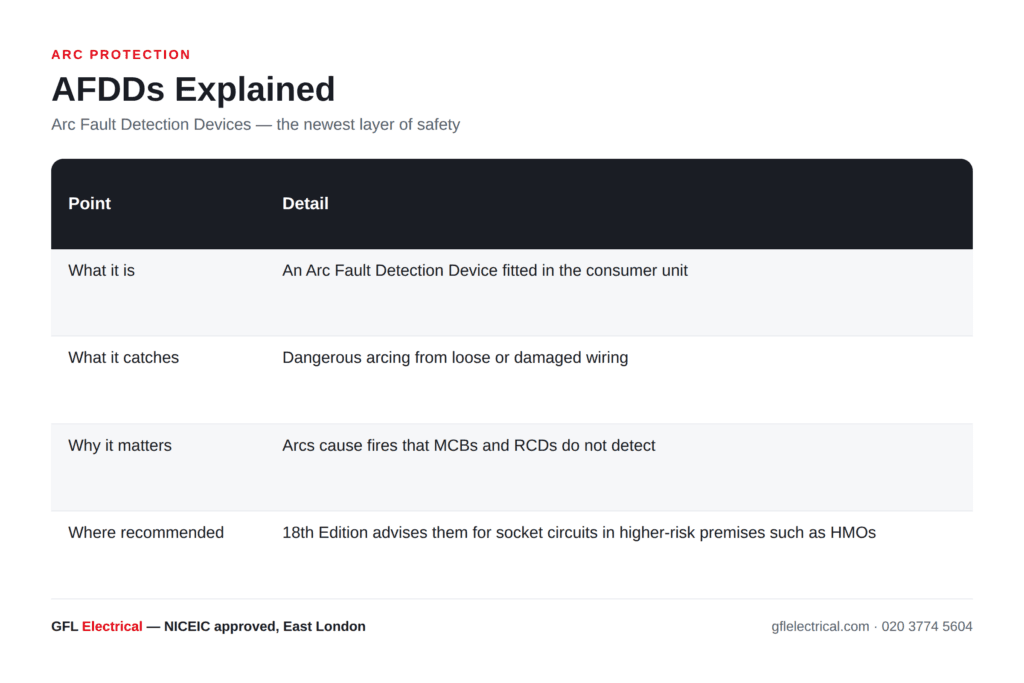
An AFDD (Arc Fault Detection Device) is a protective device fitted in the consumer unit that detects dangerous electrical arcing and disconnects the circuit before it can start a fire.
Arcing is the sparking that happens at damaged cables, loose connections, or pinched/trapped flexes — for example a cable nicked by a screw, a worn appliance lead, or a loose terminal. This arcing generates intense heat and is a leading cause of electrical fires.
Why normal protection doesn’t catch it
Here’s the key point: MCBs and RCDs don’t reliably detect arcing.
- An MCB trips on overload or short circuit — but a series arc may not draw enough current to trip it.
- An RCD trips on earth leakage — but arcing often doesn’t leak to earth.
So a dangerous arc can sit there generating heat without tripping anything — which is exactly the gap AFDDs fill. They use electronics to recognise the distinctive signature of arcing and cut the power.
Where AFDDs are now required
Under BS 7671:
- Amendment 2 (2022) required AFDDs for socket-outlet final circuits (up to 32A) in higher-risk residential buildings, HMOs, purpose-built student accommodation, and care homes.
- Amendment 4 (2026) made AFDDs mandatory on socket circuits in HMOs, student accommodation, and care homes.
- In other premises (ordinary homes), AFDDs are recommended but not mandatory.
So if you let an HMO, AFDDs on the socket circuits are now a requirement — see our HMO electrical requirements.
Should I fit them in my own home?
For a standard home they’re not required — but they’re a genuine safety enhancement, especially worth considering if:
- You have older wiring prone to deterioration
- There’s a higher fire risk (e.g. vulnerable occupants)
- You’re already upgrading the consumer unit and want maximum protection
They do add cost (more than standard breakers), so it’s a value judgement for ordinary homes — but a real upgrade in protection.
How they’re fitted
AFDDs are installed at the origin of the circuit in the consumer unit, often as a combined AFDD/RCBO device that provides arc, earth-leakage, and overload protection in one. They comply with BS EN 62606. Fitting them is part of a consumer unit upgrade — see our fuse box replacement service.
The cost angle
AFDDs are more expensive than standard breakers, which is why an HMO board upgrade now costs more than it used to — a legitimate, regulation-driven increase, not an upsell. For ordinary homes, you’re weighing the extra cost against the extra protection.
Want AFDD protection?
Whether you’re an HMO landlord who now needs AFDDs, or a homeowner wanting the extra fire protection, GFL Electrical fit AFDD-equipped consumer units across East London to the current regulations. Call 020 3774 5604 or see our fuse box replacement service.
Based in East London? GFL Electrical are NICEIC-approved electricians covering Leyton, Walthamstow, Hackney, Stratford and the surrounding boroughs. See our consumer unit upgrades, or the areas we cover.

0 Comments