
EV Charger Installation in the UK: Cost, Grants, and the Process (2026)
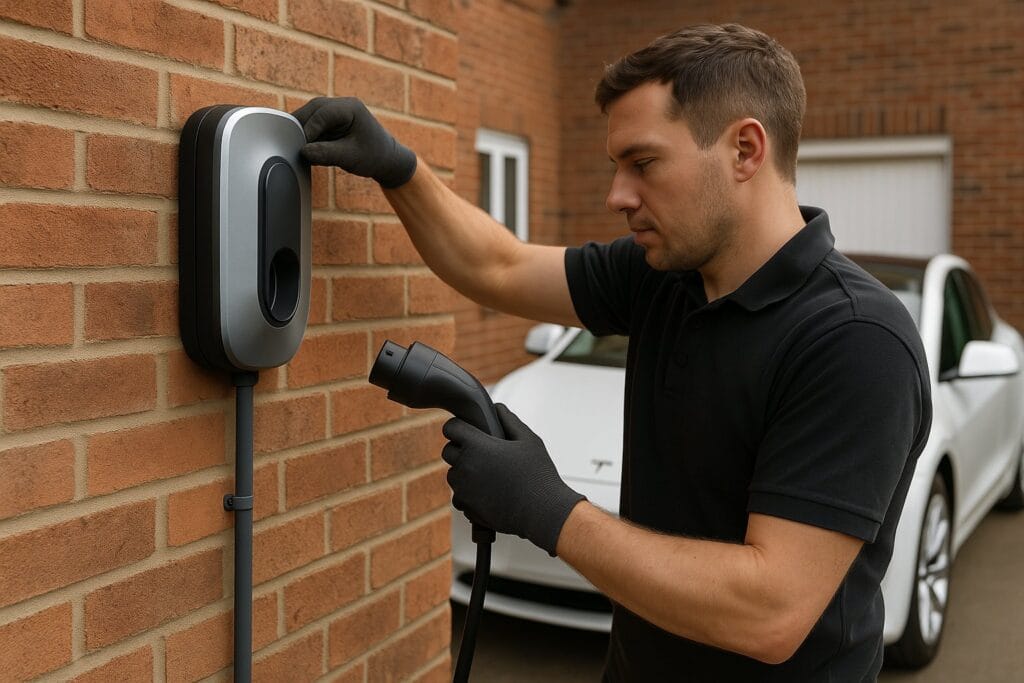
You have got the electric car, or you are about to, and now you need somewhere to plug it in at home. Then the questions start: 7kW or 22kW? Tethered or untethered? Is there still a grant? Why does it cost what it costs, and who is allowed to fit it? This guide answers all of that in plain English — what a home EV charger costs in 2026, who can still claim a grant, what the installation actually involves, and how to avoid the expensive mistakes we see when a charger is fitted on the cheap.
GFL Electrical are NICEIC-approved electricians in East London, and EV chargepoints are one of the fastest-growing parts of our work. Here is what you need to know before you book.
Why you need a dedicated charger, not a three-pin socket
It is tempting to think you can just run an extension lead to a normal socket. You can, technically, but you should not make it a habit. A standard 13A socket was never designed to deliver high current for hours at a time, and using one repeatedly to charge a car risks overheating the socket and the wiring behind it.
A dedicated EV wallbox changes that. A 7kW unit charges roughly 8–10 times faster than a three-pin socket, is purpose-built to run safely for hours, includes the right protective devices, and — importantly — is the only option that qualifies for a government grant. For most homes, a properly installed 7kW wallbox is the right answer.
7kW vs 22kW, tethered vs untethered
Two decisions shape which unit you buy.
7kW vs 22kW
A 7kW charger is the standard for homes. It adds roughly 25–30 miles of range per hour — enough to fully charge most cars overnight. It runs on a normal single-phase domestic supply, which is what nearly all UK homes have.
A 22kW charger charges faster, but it needs a three-phase electricity supply, which most houses do not have. Upgrading to three-phase is expensive and rarely worth it for home use. Unless you already have three-phase, 7kW is almost certainly your unit.
Tethered vs untethered
A tethered charger has the cable permanently attached — convenient, no cable to fetch from the boot, but you are tied to that connector type and cable length.
An untethered (socketed) charger has no fixed cable; you plug in your own. It looks tidier, suits households with different cars, and means a damaged cable is cheaper to replace. Untethered units are also the ones most commonly referenced in grant pricing.
Neither is “better” — it is about how you live with it.
What does EV charger installation cost in 2026?
For a standard home installation, expect to pay roughly £700–£1,200 all-in — that is the charger unit plus labour, materials, and the DNO notification (more on that shortly). A typical 7kW untethered smart charger fitted on a straightforward job sits at the lower-to-middle of that range.
What pushes the price up:
- Long or awkward cable runs — for example, taking a cable underground to a detached garage.
- A consumer unit (fuse board) that needs upgrading to add the EV circuit safely.
- Difficult routing through thick walls, around the property, or to a parking space far from the meter.
The cheapest quote is not always the bargain it looks. As you will see below, cutting corners on an EV install has real consequences — this is one job where you are paying for it to be done properly.
OZEV grants: who actually qualifies in 2026?
This is the most misunderstood part, because the rules changed. The OZEV EV Chargepoint Grant covers 75% of the purchase and installation cost, up to £500 per socket (raised from £350), with the scheme currently running to March 2027.
But eligibility is now limited, and most homeowners are surprised by it. You generally qualify if you are:
- A renter in residential accommodation,
- A flat owner (leasehold or share of freehold), or
- A landlord installing chargepoints for tenants.
Crucially, standard homeowners living in houses with their own driveway generally no longer qualify for this grant. So if you own a semi with off-street parking, you most likely pay the full cost — worth knowing before you budget around a grant that may not apply to you.
Two rules that catch people out if you *are* eligible:
- You must use an OZEV-approved installer — the grant cannot be claimed otherwise.
- You must apply and be approved before the charger is installed. Having it fitted first makes you ineligible. OZEV can take up to around 10 working days to assess an application.
The installation process and timeline
Here is what actually happens from enquiry to a working charger.
- Survey / assessment. We check your electricity supply, your consumer unit’s spare capacity, where the car parks, and the best cable route. Often this can be done with photos.
- DNO notification. Before installation, your Distribution Network Operator usually has to be notified that a charger is being added to the supply. This is a paperwork step, but allow 2–10 working days for it.
- Installation day. A standard 7kW install takes 2–4 hours. We mount the wallbox, run and protect the cable, fit a dedicated circuit with the correct protective device, and connect it at the consumer unit.
- Testing and certification. We test the new circuit, commission the charger and its app, and issue an Electrical Installation Certificate (EIC) for the work.
More complex jobs — underground cabling, a consumer unit upgrade, or a tricky route — can take a full day.
What goes wrong when a charger is installed badly
This is the part worth reading twice, because it is where people get hurt — financially and literally.
We regularly hear from people whose charger was fitted cheaply and caused problems later. One common story: a charger installed with undersized cable or the wrong protective device quietly overheats for months or years, until one morning the circuit trips and there is a burning smell at the consumer unit. By then there can be scorch damage to the board. Another recurring issue is a loose or poorly made connection at the fuse board, which arcs and overheats over time. And outside, a charger that was left without proper weatherproofing — no drip loop, gaps not sealed — lets water track in.
The fix for all of this is not exotic. It is a competent installer who sizes the cable correctly, fits the right type of RCBO for an EV circuit, terminates connections properly, weatherproofs the outdoor work, and certifies the installation. EV circuits have specific protection requirements precisely because the car draws high current for long periods — getting them right is the whole job.
How to choose an EV charger installer
A 60-second check protects you from the problems above.
Look for OZEV approval (if claiming a grant) and NICEIC registration
If you are eligible for the grant, your installer must be OZEV-approved. Beyond that, NICEIC registration means their work is independently assessed against the wiring regulations — the clearest signal of competence. GFL Electrical are NICEIC approved.
Ask what protection they will fit
A good installer can tell you they will fit a dedicated circuit with the correct RCBO for EV charging and appropriately sized cable. Vagueness here is exactly how the overheating stories start.
Make sure you get the certificate
You should receive an Electrical Installation Certificate for the new circuit. It proves the work is safe and you will want it for your records and any future sale.
Check they handle the DNO notification
A professional installer manages the DNO paperwork for you rather than leaving you to discover it later.
Do you have what you need?
Before booking, it helps to know a charger install assumes a few things: somewhere to park the car within reasonable cable reach of the property, a consumer unit with capacity (or the willingness to upgrade it), and an electricity supply that can take the extra load — which, for a 7kW unit on a normal home, it almost always can. If anything is borderline, a good installer will flag it at the survey rather than on the day.
Frequently asked questions
How much does it cost to install a home EV charger in 2026? Typically £700–£1,200 all-in for a standard 7kW unit, including the charger, labour, materials, and DNO notification. Long cable runs or a consumer unit upgrade push it higher.
Can I still get a government grant? Only some people now. The OZEV grant covers 75% up to £500 per socket but mainly for renters, flat owners, and landlords — most homeowners with a driveway no longer qualify. If eligible, you must use an OZEV-approved installer and apply before installation.
Should I get 7kW or 22kW? 7kW for almost all homes — it fully charges most cars overnight and runs on a normal supply. 22kW needs a three-phase supply that most houses do not have.
Tethered or untethered — which is better? Tethered is more convenient (cable always attached); untethered is tidier, more flexible for different cars, and cheaper to fix if a cable is damaged. It is a personal preference.
How long does installation take? A standard 7kW install takes 2–4 hours on the day. Allow an extra 2–10 working days beforehand for DNO notification.
Can I just use a normal three-pin plug instead? Occasionally, but not as your regular method — a standard socket is not built for hours of high-current charging and can overheat. A dedicated wallbox is far faster and safer.
Do I need to tell my electricity network (DNO)? Usually yes — adding a charger to your supply generally requires DNO notification. A professional installer handles this for you.
What certificate should I get afterwards? An Electrical Installation Certificate (EIC) for the new circuit, confirming it was installed and tested to standard.
Get a clear EV charger quote
If you are weighing up a home charger and want straight answers rather than a confusing quote, tell us where the car parks, how far that is from your meter, and whether you own or rent — and we will tell you the right unit, what it will cost, and whether any grant applies to you. No pressure, just honest advice from NICEIC-approved electricians.
See our EV charger installation service for East London, or get in touch for a quote.
Based in East London? GFL Electrical are NICEIC-approved electricians covering Leyton, Walthamstow, Hackney, Stratford and the surrounding boroughs. See all the areas we cover, or get a quote.

0 Comments