
The EICR Inspection Process: What to Expect (Step by Step)
Booked an EICR, or thinking about it, and wondering what actually happens on the day? This is a plain walkthrough of the process — how to prepare, what gets tested, whether your power goes off, and what you’re left with at the end.
Before the day: how to prepare
A little prep makes the inspection quicker and more thorough:
- Clear access to the consumer unit (fuse box), sockets, and switches — move furniture away from key points.
- Have any previous certificates or reports to hand.
- For tenanted properties, arrange access and let occupants know the power will be off at times.
- Note any known issues (a socket that sparks, a circuit that trips) to mention.
What the electrician actually does
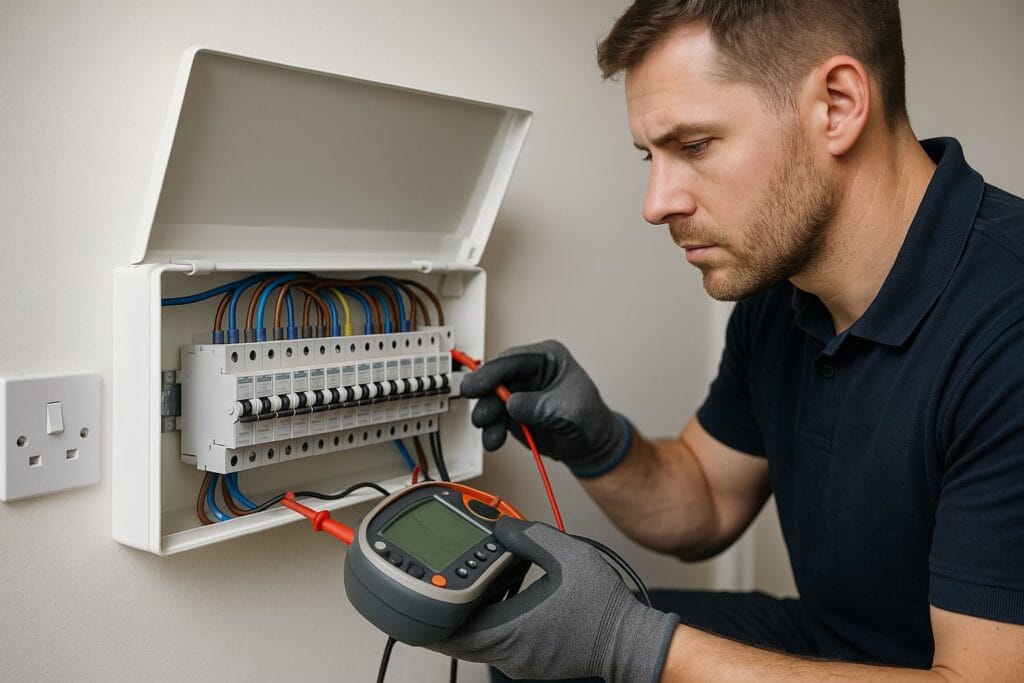
An EICR is part inspection (visual) and part testing (with instruments):
- Visual inspection — checking the consumer unit, accessible wiring, sockets, switches, and fittings for damage, wear, overheating, and obvious non-compliance.
- Dead testing — with the power off, testing continuity, insulation resistance, and polarity of circuits. This is why the power goes off in stages.
- Live testing — with power on, checking earth fault loop impedance and RCD operation (they’ll trip RCDs deliberately to confirm they work).
- Sampling — they’ll open a representative number of sockets/switches to inspect connections behind them.
Will my power go off?
Yes — but usually circuit by circuit, not all day. The dead-testing stage needs circuits isolated, so expect power to come and go in areas as they work. For most homes it’s manageable; for businesses we schedule around your hours. Tell the electrician in advance about anything that can’t lose power (e.g. medical equipment, server rooms) so they can plan.
How long does it take?
Depends on size and circuit count:
- Flat / small home: 2–3 hours
- Average house: 3–4 hours
- Large or older property with many circuits: most of a day
A thorough EICR isn’t a 30-minute tick-box exercise — proper testing takes time, and that’s exactly what you want.
The report and its codes
Afterwards you get the EICR document, marked satisfactory or unsatisfactory, with any observations coded:
- C1 — danger present (immediate action)
- C2 — potentially dangerous (urgent remedial)
- C3 — improvement recommended (not a fail)
- FI — further investigation required
Any C1, C2, or FI makes the report unsatisfactory. Our EICR codes guide explains each in plain terms, and a good electrician will talk you through yours.
What happens if it’s unsatisfactory?
Don’t panic — it’s common, especially in older homes. You’ll get a list of remedial work needed to bring it up to standard. For landlords, C1/C2/FI items must be fixed within 28 days (see our landlord EICR rules). The electrician should quote clearly for the remedial work — separately from the inspection — so you can decide.
After remedial work
Once any issues are fixed, you receive written confirmation (and certification for the work) that the installation now meets the standard. Landlords pass this to tenants and, on request, the council.
Book your EICR
Now you know what to expect, the rest is straightforward. GFL Electrical carry out EICRs across East London with clear, properly coded reports and honest advice on any remedial work. See our EICR testing service or call 020 3774 5604.
Based in East London? GFL Electrical are NICEIC-approved electricians covering Leyton, Walthamstow, Hackney, Stratford and the surrounding boroughs. See all the areas we cover, or get a quote.

0 Comments