
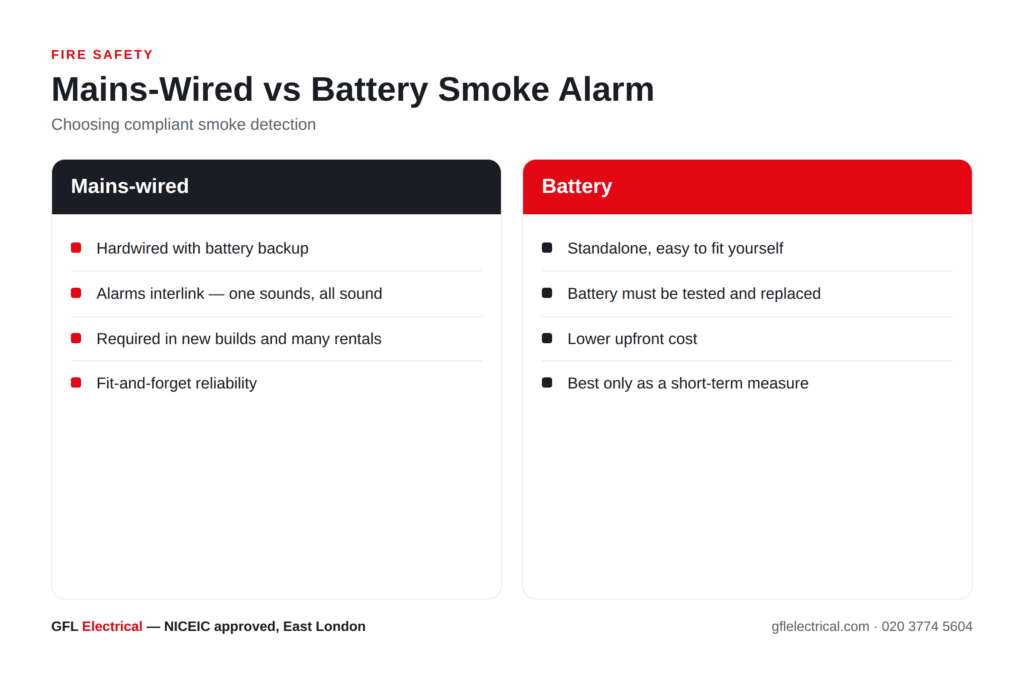
Should you have mains-powered or battery smoke alarms? For a quick standalone fix, battery is fine — but for real protection and for most compliance situations, mains-powered interlinked alarms win. Here’s the honest comparison.
The three types
- Standalone battery alarms — self-contained, battery only. Cheap, DIY-fittable, but isolated.
- Mains-powered (hard-wired) alarms — wired into your electrics, with a battery backup for power cuts. Usually interlinked.
- Mains with sealed long-life battery — a middle ground; mains-powered with a 10-year sealed backup.
The real difference: interlinking
The biggest safety factor isn’t mains vs battery — it’s whether alarms are interlinked. Interlinked alarms all sound together when any one detects smoke, so a fire downstairs wakes people upstairs. Standalone alarms only sound where the smoke is — which can be too late at night.
Mains-powered alarms are typically interlinked (hard-wired or via radio). That’s why they’re the safer choice for a whole home.
Mains: pros and cons
Pros
- Always powered — no flat-battery gaps
- Interlinked — whole-home warning
- The standard for new installs under BS 5839-6
- Battery backup for power cuts
Cons
- Needs an electrician to install
- Higher upfront cost than standalone
Battery: pros and cons
Pros
- Cheap and instantly fittable
- No wiring needed
Cons
- Flat/removed batteries are a leading cause of alarm failure
- Usually not interlinked (some radio-interlinked battery models exist)
- Not sufficient where interlinked mains is required (new builds, rewires, many lets)
What the rules expect
- Every home should have a smoke alarm on every storey, and a CO alarm in any room with a fixed combustion appliance.
- For new installations and rewires, the standard is interlinked, mains-powered alarms.
- Landlords must provide working alarms and ensure they work at the start of each tenancy — see our smoke alarm regulations guide.
What about period homes (can’t run cables)?
You don’t have to choose between safety and your plaster. Radio-interlinked alarms link wirelessly — you get whole-home interlinking (mains or long-life battery) without chasing cables through original features. Ideal for period properties.
The verdict
- New build / rewire / renovation: interlinked mains — it’s the standard and the safest.
- Landlord: interlinked mains (or radio-interlinked) to meet your duty reliably.
- Quick interim fix or supplementing: standalone battery is better than nothing — but plan to upgrade.
- Period home: radio-interlinked for whole-home protection without the mess.
The headline: interlinking matters more than the power source, and mains alarms are the standard way to get it.
Upgrade your alarms
For interlinked mains or radio-interlinked smoke, heat, and CO alarms fitted properly across East London, GFL Electrical are your local NICEIC electricians. See our fire & smoke alarm service or call 020 3774 5604.


0 Comments