
10 Signs Your House Needs Rewiring (UK Guide)

Rewiring is a big job, so it’s worth knowing whether yours genuinely needs it or just some remedial work. Here are the clearest signs an installation is past its safe life — and how to confirm it before committing to anything.
1. An old-style fuse box
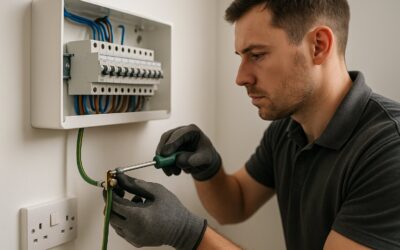
A consumer unit with rewireable fuses (where you replace a fuse wire) or no RCD protection usually dates the installation to decades ago. It’s the single most visible clue. A modern board has breakers and RCD/RCBO protection.
2. Rubber, fabric, or lead-sheathed cabling
If you can see cabling (in the loft, under the stairs, at the meter) and it has rubber or fabric insulation, or a lead sheath, it’s likely pre-1970s and the insulation may be perishing. This is a strong rewire indicator.
3. Not enough sockets
Homes wired decades ago have far fewer sockets than modern life needs. If you rely on extension leads and multi-way adaptors everywhere, the installation is undersized — and a rewire is the chance to fix it.
4. Frequent tripping or blown fuses
Persistent tripping that isn’t down to one faulty appliance can indicate deteriorating wiring or an overloaded, outdated installation.
5. Scorch marks, discolouration, or warm fittings
Browning around sockets/switches, scorch marks, or fittings that feel warm point to loose connections or overheating — a safety concern that, if widespread, suggests the installation needs replacing.
6. A burning smell
A persistent burning smell from sockets is a red flag — switch off and get it checked urgently. If faults are widespread, a rewire may be the answer.
7. Flickering or dimming lights
Occasional flicker is usually a bulb; widespread, persistent flickering across the house can indicate ageing wiring or connections.
8. Old round-pin sockets or braided flex
Round-pin sockets, brown braided flexes, mounted light switches in odd places, or black rubber cabling are all hallmarks of a very old installation that hasn’t been touched in generations.
9. No earthing on key circuits
Older installations may lack proper earthing and bonding — a serious safety gap that often accompanies the need for a rewire. An inspection will confirm.
10. It’s simply never been done
If there’s no record of any electrical work or inspection for 30–40+ years, the installation is likely original and overdue at least a thorough check.
How to confirm it: get an EICR
You don’t have to guess. An EICR (Electrical Installation Condition Report) is a thorough inspection that tells you the true condition of the wiring and whether a full rewire, a partial rewire, or just remedial work is needed. It’s the honest way to decide — see our EICR testing service. A good electrician won’t push a full rewire if a partial rewire or repairs will do.
Full rewire or partial?
Not every ageing home needs a complete rewire. Sometimes the wiring is sound but the board needs upgrading; sometimes only certain circuits need replacing. An inspection determines which — and saves you money if a full rewire isn’t warranted.
What rewiring involves
If it is needed, a rewire replaces the cabling, sockets, switches, and consumer unit, brings everything up to BS 7671 with modern protection, and adds the sockets and circuits modern living needs. See our house rewiring service and house rewire cost guide.
Not sure? Get it checked
If you’ve spotted some of these signs, the next step is an inspection, not a guess. GFL Electrical carry out EICRs and rewiring across East London, and we’ll tell you honestly what’s needed. Call 020 3774 5604 or get in touch.
Based in East London? GFL Electrical are NICEIC-approved electricians covering Leyton, Walthamstow, Hackney, Stratford and the surrounding boroughs. See all the areas we cover, or get a quote.


0 Comments